PCB Certifications Guide: UL, ISO, IATF, IPC, RoHS Compliance
Master the essential PCB certifications guide: UL, ISO 9001, IATF 16949, IPC, and RoHS. This comprehensive guide explains what each certification means, why it matters for your PCB supply chain, and how to verify compliance for reliable, high-quality circuit board manufacturing.
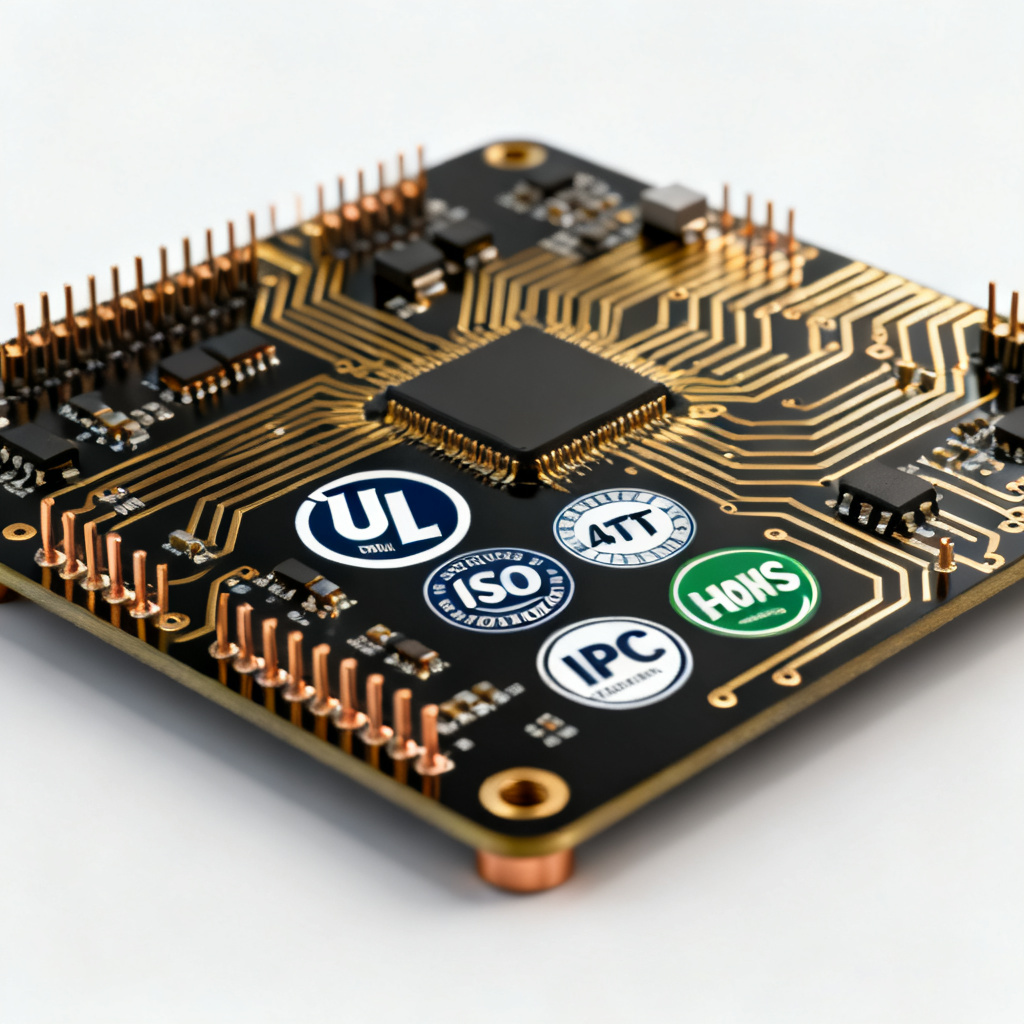
1. UL Certification for PCB Safety
What is UL Certification?
UL is a globally recognized safety certification organization. For PCBs, UL 796 is the primary standard covering the safety of printed wiring boards. UL certification ensures that the base materials (laminate, prepreg), the finished board, and the manufacturing process meet strict fire and electrical safety standards.
Key Aspects of UL Certification for PCBs
- Flammability Rating: The most common rating is UL 94 V-0, meaning the material stops burning within 10 seconds after removal of the ignition source, with no flaming drips. Other ratings include V-1, V-2, HB, and 5VA.
- Material Recognition: UL lists approved laminate and prepreg materials. A certified PCB manufacturer must use only UL-recognized materials.
- Process Control: UL audits the manufacturer’s process to ensure consistent quality, including solder mask adhesion, dielectric strength, and thermal performance.
- Marking: Certified boards bear a UL mark, typically a “UL” logo with a control number or “R” (Recognized Component) mark.
Why UL Matters for B2B Buyers
- Safety Compliance: Many end-products (e.g., power supplies, lighting, appliances) require UL-certified PCBs for final product safety certification.
- Insurance & Liability: Using non-UL boards can void insurance claims or lead to liability issues in case of fire or electrical failure.
- Market Access: Products sold in North America often require UL certification. Even for global markets, UL is a de facto standard for safety.
How to Verify UL Certification
- Ask for the manufacturer’s UL File Number (e.g., E123456).
- Check the UL Online Certifications Directory (www.ul.com/database).
- Ensure the UL mark is present on the PCB or packaging.
2. ISO 9001:2015 – Quality Management System for PCB Manufacturing
What is ISO 9001?
ISO 9001 is the international standard for Quality Management Systems (QMS). It is not a product certification but a process certification, ensuring that a manufacturer consistently meets customer and regulatory requirements through a systematic approach to quality.
Key Requirements of ISO 9001:2015 for PCB Manufacturers
- Process Approach: All manufacturing steps (design, material procurement, etching, lamination, drilling, testing) are documented, controlled, and continuously improved.
- Risk-Based Thinking: The manufacturer identifies and mitigates risks (e.g., material shortages, equipment failure, process variation).
- Customer Focus: Feedback, complaints, and requirements are systematically handled.
- Documentation Control: Procedures, work instructions, and records are maintained and auditable.
- Internal Audits & Management Review: Regular audits ensure the QMS remains effective.
Why ISO 9001 Matters for PCB Certifications
- Consistency: ISO 9001-certified manufacturers deliver repeatable quality, reducing defect rates and rework.
- Traceability: Full traceability from raw material to finished board is standard.
- Global Recognition: ISO 9001 is the baseline for most B2B PCB sourcing. Without it, many buyers will not consider a supplier.
Beyond ISO 9001: AS9100 (Aerospace) and ISO 13485 (Medical)
- AS9100D: Adds aerospace-specific requirements (e.g., configuration management, counterfeit part prevention, special process control). Essential for PCBs used in aircraft systems.
- ISO 13485:2016: For medical device PCBs, this standard emphasizes risk management, design control, and sterilization compatibility.

3. IATF 16949 – Automotive PCB Certification
What is IATF 16949?
IATF 16949 is the global automotive quality management standard, developed by the International Automotive Task Force. It is based on ISO 9001 but adds stringent automotive-specific requirements for defect prevention, waste reduction, and supply chain management.
Key IATF 16949 Requirements for PCB Manufacturers
- Product Safety: Special emphasis on safety-related components (e.g., airbag, brake, steering systems). The manufacturer must have a product safety policy and process for identifying safety-critical characteristics.
- Error-Proofing (Poka-Yoke): Processes must be designed to prevent defects, not just detect them.
- PPAP (Production Part Approval Process): The manufacturer must submit PPAP documentation (design records, FMEA, control plan, measurement system analysis) for each new part.
- FMEA (Failure Mode and Effects Analysis): Design and process FMEA are mandatory to identify and mitigate potential failures.
- Control Plan: A detailed plan for controlling all manufacturing steps, including inspection frequencies and reaction plans.
- MSA (Measurement System Analysis): All measurement equipment must be statistically validated.
- Supplier Management: The PCB manufacturer must manage its own raw material suppliers to the same high standards.
- Warranty Management: A system to analyze field failures and implement corrective actions.
Why IATF 16949 Matters for Automotive PCBs
- Zero Defect Philosophy: Automotive electronics demand near-zero PPM defect rates. IATF 16949 is the only standard that enforces this rigor.
- Customer-Specific Requirements (CSRs): Major automakers (e.g., Ford, GM, VW) have their own CSRs that IATF 16949-certified suppliers must meet.
- Avoiding Downtime: A single PCB failure can halt an entire assembly line. IATF 16949 reduces this risk.
How to Verify IATF 16949
- Check the manufacturer’s IATF Certificate Number.
- Verify on the IATF Global Oversight Database (www.iatfglobaloversight.org).
- Note that IATF 16949 certification is site-specific, not company-wide.
4. IPC Standards – The Language of PCB Quality
What is IPC?
IPC (Institute of Printed Circuits, now IPC – Association Connecting Electronics Industries) develops the most widely used standards for PCB design, manufacturing, assembly, and acceptance. IPC standards define classes of product quality and provide detailed acceptance criteria.
Key IPC Standards for PCB Manufacturing
- IPC-6011: Generic Performance Specification for Printed Boards.
- IPC-6012: Qualification and Performance Specification for Rigid PCBs. This is the most commonly referenced standard.
- IPC-6013: For Flexible and Rigid-Flex PCBs.
- IPC-6018: For High-Frequency (Microwave) PCBs.
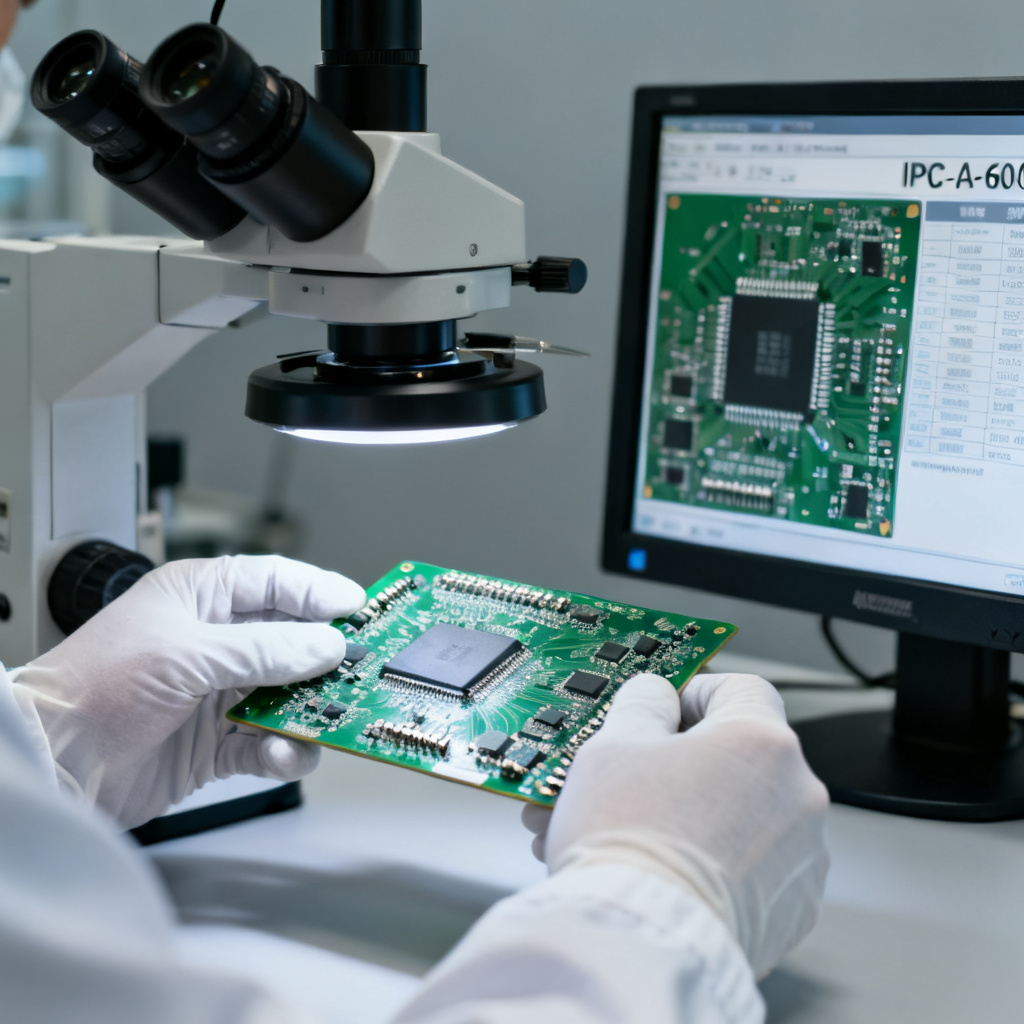
- IPC-A-600: Acceptability of Printed Boards. A visual standard with photographs of acceptable and rejectable conditions.
- IPC-2221: Generic Standard on Printed Board Design.
- IPC-7351: Generic Requirements for Surface Mount Design and Land Pattern Standard.
IPC Class Definitions
| Class | Description | Typical Applications |
|---|---|---|
| Class 1 | General Electronic Products | Consumer electronics, toys, simple appliances |
| Class 2 | Dedicated Service Electronic Products | Industrial equipment, telecommunications, computers |
| Class 3 | High Reliability Electronic Products | Medical life support, aerospace, military, automotive safety |
What IPC Certification Means for a Manufacturer
- IPC-A-600 Certification: The manufacturer’s inspectors and quality staff are trained to recognize acceptable vs. rejectable conditions per IPC-A-600.
- IPC-6012 Class 2 or 3 Compliance: The manufacturer’s process is capable of producing boards that meet Class 2 or Class 3 requirements, including tighter tolerances, stricter cleanliness, and enhanced reliability testing.
- IPC-7711/7721: For rework and repair of electronic assemblies.
Why IPC Matters for B2B Buyers
- Clear Specifications: IPC standards eliminate ambiguity. You can specify exactly what you need (e.g., “IPC-6012 Class 3”).
- Incoming Inspection: You can use IPC-A-600 to inspect and accept/reject incoming PCBs.
- Supplier Qualification: Asking “Are you IPC-6012 Class 3 certified?” is a direct way to assess capability.
5. RoHS and REACH – Environmental Compliance
What is RoHS?
RoHS (Restriction of Hazardous Substances) is a European Union directive (2011/65/EU) that restricts the use of certain hazardous materials in electrical and electronic equipment. For PCBs, the key restriction is on lead (Pb) in solder and finishes.
Restricted Substances (RoHS 3 – 2015/863)
- Lead (Pb) – max 0.1%
- Mercury (Hg) – max 0.1%
- Cadmium (Cd) – max 0.01%
- Hexavalent Chromium (Cr6+) – max 0.1%
- Polybrominated Biphenyls (PBB) – max 0.1%
- Polybrominated Diphenyl Ethers (PBDE) – max 0.1%
- Bis(2-Ethylhexyl) phthalate (DEHP) – max 0.1%
- Benzyl butyl phthalate (BBP) – max 0.1%
- Dibutyl phthalate (DBP) – max 0.1%
- Diisobutyl phthalate (DIBP) – max 0.1%
RoHS Compliance for PCBs
- Lead-Free Finish: The most common RoHS-compliant finishes are ENIG (Electroless Nickel Immersion Gold), HASL (Hot Air Solder Leveling) with lead-free solder, OSP (Organic Solderability Preservative), and Immersion Silver.
- Laminate Materials: Standard FR-4 is generally RoHS-compliant, but some high-temperature laminates may contain restricted flame retardants (e.g., PBBs). Always request a RoHS Declaration of Compliance.
- Marking: RoHS-compliant PCBs are often marked with a “RoHS” or “Pb-free” symbol, though this is not mandatory.
What is REACH?
REACH (Registration, Evaluation, Authorisation and Restriction of Chemicals) is a European regulation (EC 1907/2006) that goes beyond RoHS. It requires manufacturers to identify and manage risks from all chemicals used in their products.
- SVHC (Substances of Very High Concern): REACH maintains a Candidate List of SVHCs (e.g., certain phthalates, flame retardants). Manufacturers must disclose if their PCBs contain any SVHC above 0.1% by weight.
- Scope: REACH covers all chemicals, not just the 10 restricted in RoHS.
Why RoHS/REACH Matters
- Legal Compliance: Selling products in the EU without RoHS compliance is illegal.
- Global Trend: Many other regions (China, California, Japan, Korea) have adopted similar restrictions.
- Customer Demand: Most B2B buyers require RoHS compliance as a baseline.
How to Verify RoHS/REACH Compliance
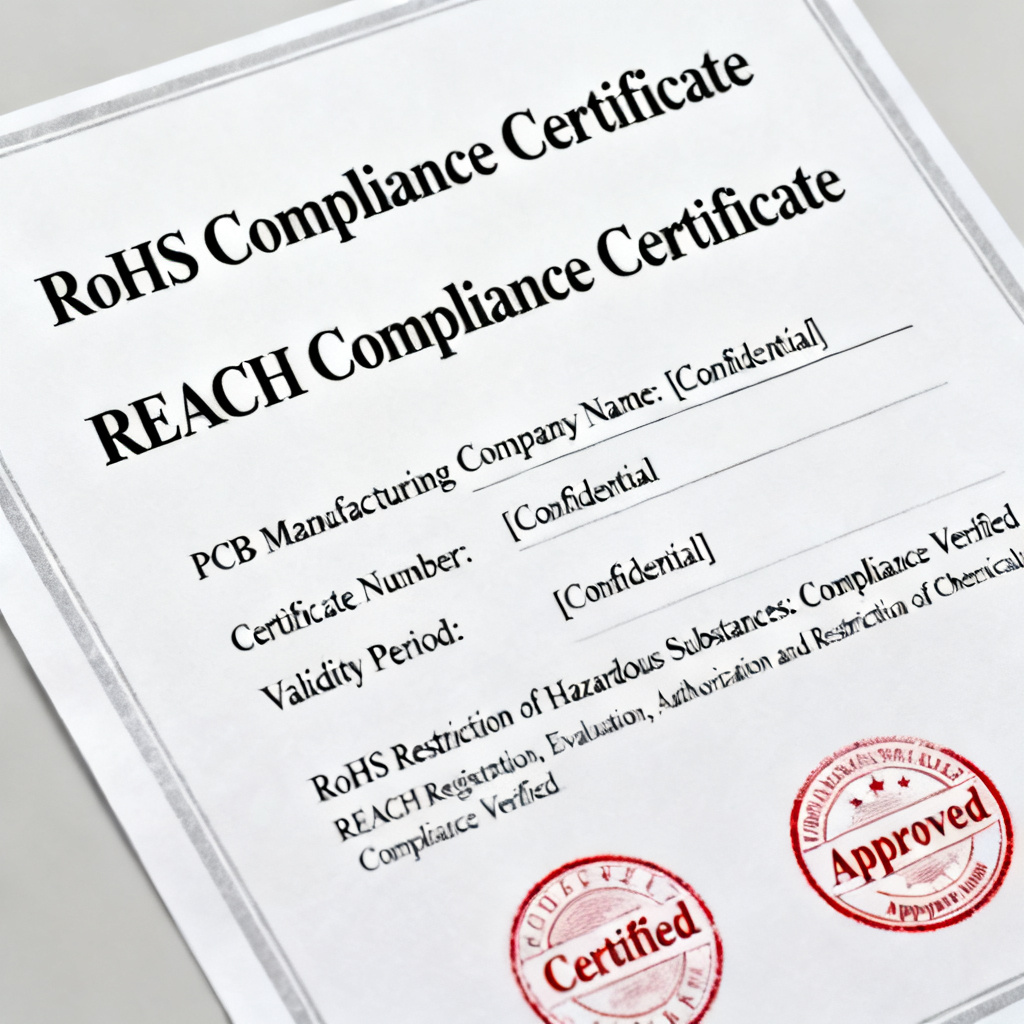
- Request a RoHS Certificate of Compliance from the manufacturer.
- Ask for a REACH Declaration or a list of SVHCs present.
- For high-reliability applications (e.g., automotive, aerospace), ensure the lead-free finish is compatible with your assembly process (e.g., tin whisker risk with pure tin).
Comparison Table: Which PCB Certification Do You Need?
| Certification | Focus Area | Typical Applications | Key Standard |
|---|---|---|---|
| UL | Safety (fire, electrical) | Appliances, power supplies, lighting | UL 796, UL 94 V-0 |
| ISO 9001 | Quality management system | All industries (baseline) | ISO 9001:2015 |
| IATF 16949 | Automotive quality | Automotive electronics, safety systems | IATF 16949 |
| AS9100 | Aerospace quality | Avionics, satellites, military | AS9100D |
| ISO 13485 | Medical device quality | Diagnostic equipment, implants | ISO 13485:2016 |
| IPC-6012 | Product performance & acceptance | High-reliability, military, medical | IPC-6012 Class 2/3 |
| RoHS | Hazardous substance restriction | All electronics sold in EU | Directive 2011/65/EU |
| REACH | Chemical safety & registration | All products sold in EU | EC 1907/2006 |
How to Verify a PCB Manufacturer’s Certifications
- Request Official Certificates: Ask for scanned copies of UL, ISO, IATF, or other certificates. Check the issue date, scope, and auditing body.
- Check Online Databases:
- UL: www.ul.com/database
- IATF: www.iatfglobaloversight.org
- ISO: Check the registrar’s website (e.g., BSI, SGS, TÜV).
- Audit the Manufacturer: Schedule a factory audit to see their QMS in action. Look for documented procedures, calibration records, and employee training.
- Request a Sample Report: Ask for a copy of a recent IPC-A-600 inspection report or a PPAP submission.
- Ask for Material Certifications: Ensure laminates and finishes are UL-recognized and RoHS-compliant.
Frequently Asked Questions About PCB Certifications
Can a PCB be UL-certified but not RoHS-compliant?
Is IPC-6012 Class 3 certification the same as IATF 16949?
Do I need IATF 16949 for an automotive PCB that is not safety-critical?
How long does it take to get IATF 16949 certification?
What is the difference between RoHS and RoHS 3?
Conclusion: Building a Certification-Driven PCB Supply Chain
Choosing a PCB manufacturer without verifying compliance can compromise your project. Use this comprehensive PCB Certifications Guide UL ISO IATF IPC RoHS to build a robust, safe, and high-quality electronic supply chain.
For B2B buyers, the most robust PCB certifications strategy is to:
- Start with ISO 9001 as a minimum requirement.
- Add UL for any product that requires safety certification.
- Add IATF 16949 or AS9100 for automotive or aerospace applications.
- Specify IPC-6012 Class 2 or 3 for high-reliability needs.
- Always require RoHS/REACH compliance unless your product has a specific exemption.
In our company, we hold all these PCB certifications and more. Contact us today to request our certification documents, a sample inspection report, or a quote for your next PCB project. We are ready to prove our quality—not just promise it.
Disclaimer: This guide is for informational purposes only. Certification requirements and standards may change. Always verify current requirements with the relevant certifying bodies and your specific customer.