Reliability Testing Thermal Cycling HAST CAF
In B2B electronics manufacturing, Reliability Testing Thermal Cycling HAST CAF is the cornerstone of PCB longevity. These three tests validate a board’s ability to withstand extreme temperatures, moisture, and voltage stress, preventing field failures in aerospace, automotive, and telecom applications.

This guide provides a deep dive into each test, covering procedures, failure mechanisms, and material recommendations. Understanding these methods is essential for any engineer or procurement specialist seeking robust, long-lasting PCB prototypes and production runs.
Why Reliability Testing – Thermal Cycling, HAST, CAF Matters for PCBs
Reliability Testing – Thermal Cycling, HAST, CAF accelerates failure modes in a controlled environment. By exposing sample boards to extreme conditions, manufacturers predict product lifespan. This data is vital for warranty validation, design qualification, and supplier auditing.
The three tests covered here are the gold standard for evaluating mechanical integrity, moisture resistance, and insulation reliability.
1. Thermal Cycling (TCT) – Testing Mechanical Fatigue
What is Thermal Cycling?
Thermal Cycling (TCT) evaluates a PCB’s ability to withstand repeated temperature changes, simulating power cycling or outdoor temperature variations.
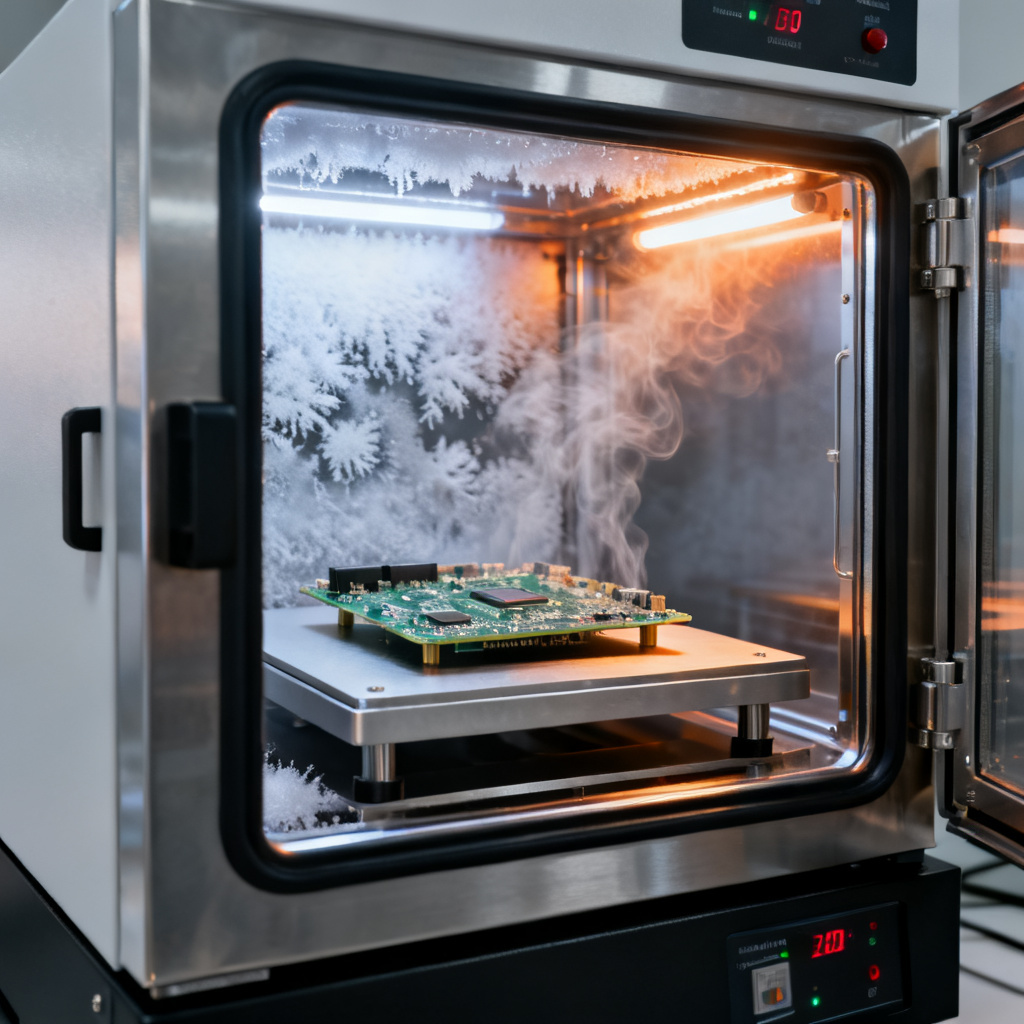
The Test Procedure for Reliability Testing – Thermal Cycling, HAST, CAF
The board cycles between extreme temperatures, typically -55°C to +125°C, with dwell times of 10-15 minutes. A standard test runs for 500 to 2000 cycles.
What It Detects
The primary failure mechanism is Coefficient of Thermal Expansion (CTE) mismatch. This causes Plated Through-Hole (PTH) barrel cracking, delamination, and solder joint failure.
How to Interpret Results
A pass condition shows no increase in resistance of daisy-chain test coupons by more than 10% (per IPC-9701). A failure mode is a sudden open circuit or resistance spike.
Design & Material Recommendations for Good TCT Performance
- Use High Tg Laminate (170°C+), Polyimide, or Rogers.
- For thick copper (>2 oz), ensure proper via filling.
- If using via-in-pad, fill with non-conductive epoxy.
- Avoid stacking vias; stagger them to distribute stress.
2. HAST (Highly Accelerated Stress Test) – Testing Moisture & Corrosion Resistance
What is HAST?
HAST evaluates a PCB’s resistance to moisture ingress, electrochemical migration, and corrosion under biased conditions. It compresses months of real-world humidity exposure into hours.
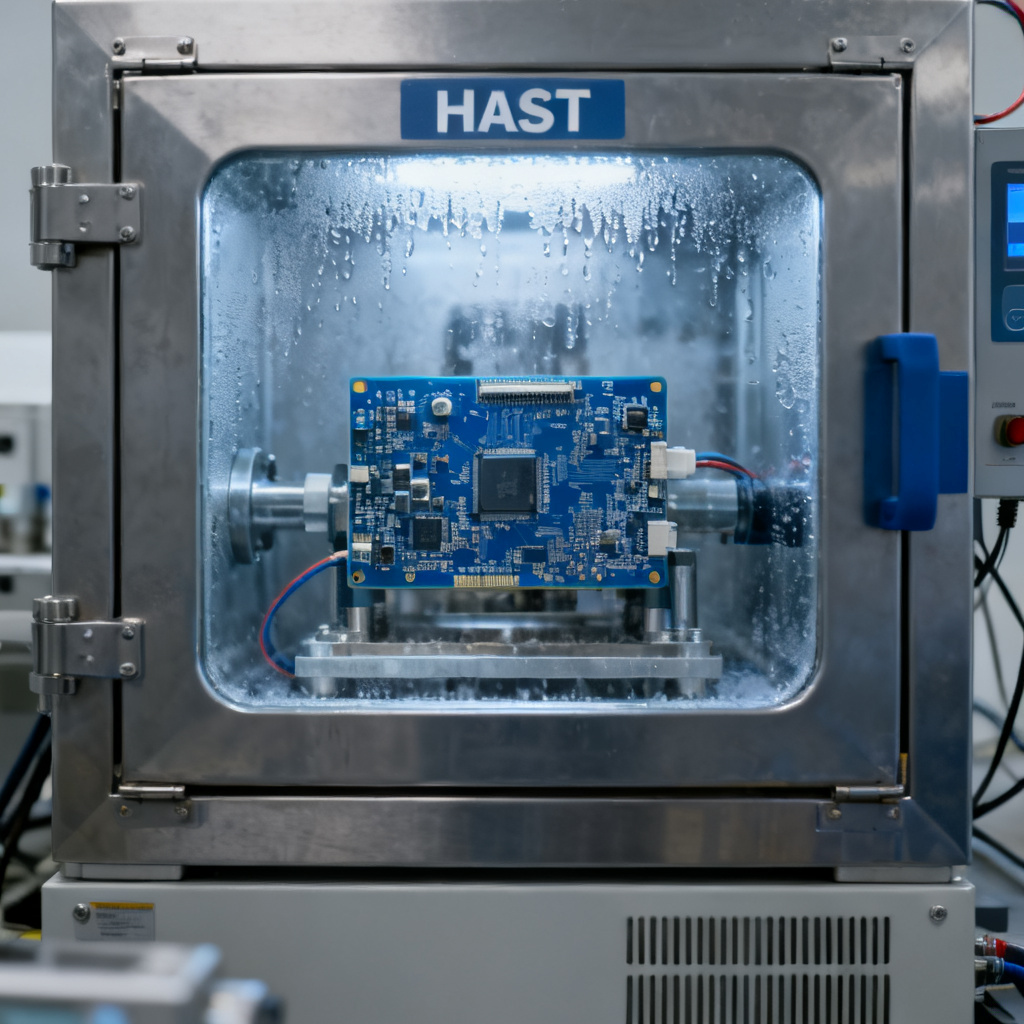
The Test Procedure for Reliability Testing – Thermal Cycling, HAST, CAF
Standard conditions per JESD22-A110 are 110°C to 130°C, 85% RH, and bias voltage of 5V to 48V DC. Typical duration is 96 hours, extendable to 264 hours.
What It Detects
HAST drives moisture into the laminate, enabling Electrochemical Migration (ECM), CAF growth, solder mask adhesion failure, and corrosion.
How to Interpret Results
A pass condition shows no significant increase in leakage current (typically <100 µA). A failure mode is a sudden spike in leakage current or visual short circuits.
Design & Material Recommendations for Good HAST Performance
- Select low-moisture-absorption laminate (<0.1% absorption).
- Use high-performance, photo-imageable solder mask.
- Thoroughly clean the board after soldering to remove hygroscopic flux.
- Apply conformal coating for extreme environments.
- Avoid sharp 90-degree trace corners; use 45-degree chamfers.
3. CAF (Conductive Anodic Filament) Testing – Testing Insulation Integrity
What is CAF?
CAF growth is a failure mechanism where a conductive salt grows along the glass fiber/resin interface inside the PCB laminate, creating an internal short circuit.
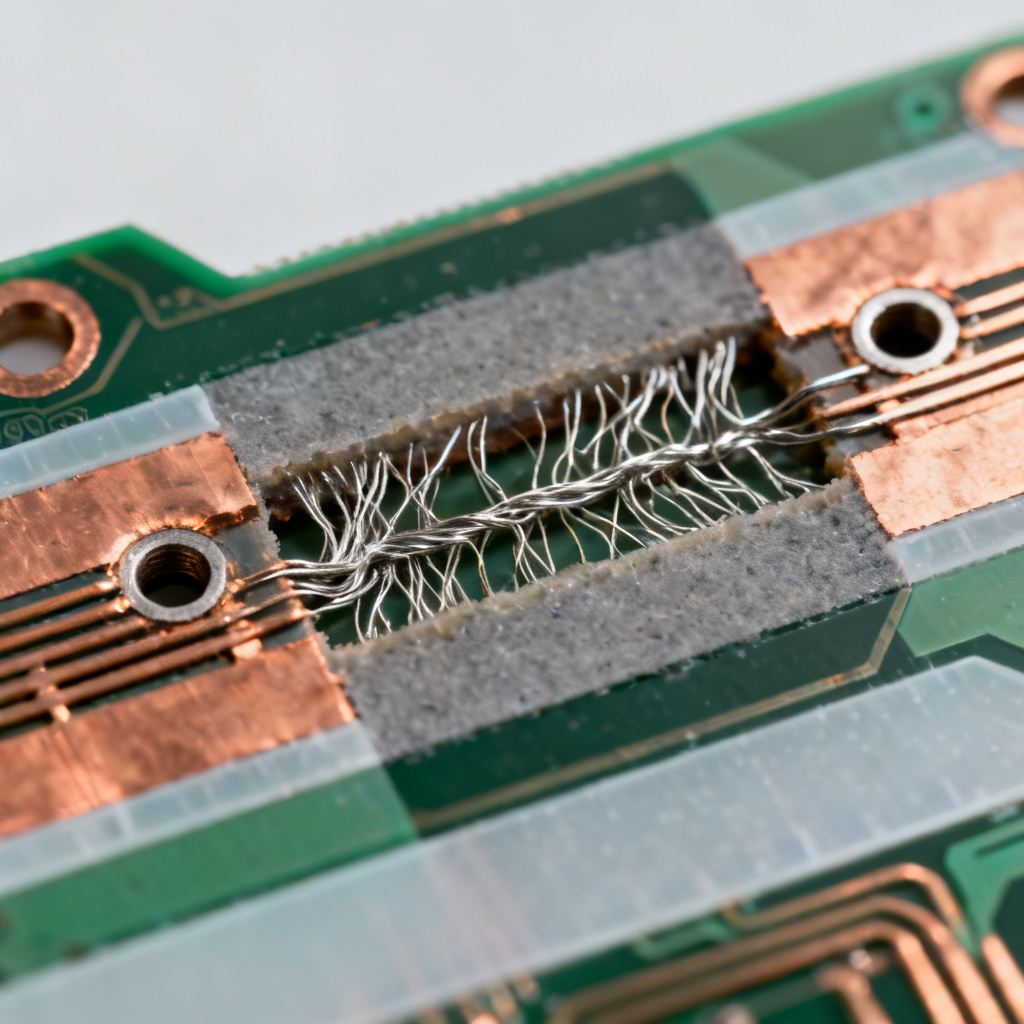
The Test Procedure for Reliability Testing – Thermal Cycling, HAST, CAF
Per IPC-TM-650 2.6.25, conditions are 85°C, 85% RH, bias voltage of 10V to 100V DC, and test duration of 1000 hours.
What It Detects
CAF growth is driven by moisture, voltage bias, and a pathway at the glass fiber-resin interface.
How to Interpret Results
A pass condition shows insulation resistance above 100 MΩ for the entire test. A failure mode is a gradual or sudden drop in IR.
Design & Material Recommendations for Good CAF Performance
- Use a CAF-resistant laminate with tight glass weave (e.g., 106, 1080, 2116).
- Require desmearing to remove resin smear and expose clean glass.
- Maintain minimum spacing of 0.5mm (20 mils) between PTHs.
- For high-voltage boards (>50V), increase spacing to 1.0mm (40 mils).
- Cover vias with soldermask (tenting) to prevent moisture ingress.
Reliability Testing – Thermal Cycling, HAST, CAF: Comparison Table
| Feature | Thermal Cycling (TCT) | HAST | CAF Testing |
|---|---|---|---|
| Primary Stress | Temperature extremes | Heat + Moisture + Pressure | Heat + Moisture + Voltage |
| Failure Mode Detected | Cracks, delamination, solder joint fatigue | Dendrites, corrosion, mask blistering | Internal copper filament growth |
| Typical Duration | 500-2000 cycles | 96-264 hours | 1000 hours |
| Key Material Parameter | CTE | Moisture absorption | Glass weave quality |
| Test Standard | IPC-9701, JESD22-A104 | JESD22-A110, IPC-TM-650 2.6.27 | IPC-TM-650 2.6.25 |
| Primary Application | Power cycling, outdoor equipment | High-humidity, automotive under-hood | High-voltage, long-life telecom |
How to Choose the Right Test for Your PCB
Reliability Testing – Thermal Cycling, HAST, CAF is not one-size-fits-all. For low-cost consumer electronics, HAST (96h) is often sufficient. For industrial and telecom, CAF testing (1000h) is highly recommended. For automotive, aerospace, and medical, all three tests are mandatory.
We recommend the following minimum for a robust prototype:
- Thermal Cycling: 500 cycles (-40°C to +125°C)
- HAST: 96 hours (130°C / 85% RH)
- CAF: 1000 hours (85°C / 85% RH / 50V)
FAQ: Reliability Testing – Thermal Cycling, HAST, CAF
What is the difference between HAST and CAF testing?
HAST focuses on surface-level electrochemical migration and corrosion, while CAF testing targets internal filament growth within the laminate. Both are part of comprehensive Reliability Testing – Thermal Cycling, HAST, CAF.
How long does a typical CAF test take?
A standard CAF test runs for 1000 hours (42 days) per IPC-TM-650 2.6.25.
Why is thermal cycling important for PCBs?
Thermal cycling validates the board’s ability to handle CTE mismatch, preventing PTH barrel cracking and solder joint failure over the product’s lifespan.
Can HAST replace CAF testing?
No. HAST and CAF test different failure mechanisms. HAST detects surface dendrites and corrosion, while CAF detects internal filament growth. Both are essential for high-reliability applications.
Industry Terminology in Reliability Testing – Thermal Cycling, HAST, CAF
- CTE (Coefficient of Thermal Expansion): The rate at which a material expands or contracts with temperature changes.
- ECM (Electrochemical Migration): The growth of conductive metal filaments across a surface under bias and moisture.
- Desmearing: A process to remove resin smear from drilled hole walls to expose clean glass fibers.
- Laminate: The insulating material (e.g., FR-4, Polyimide) that forms the core of a PCB.
Our Approach to Reliability Testing – Thermal Cycling, HAST, CAF
At [Your Company Name], we integrate these reliability tests into our standard quality workflow. Unlike many suppliers who rely on a single test, we validate all three to ensure no hidden weaknesses. Our detailed test reports include cross-section images for TCT and CAF, providing complete transparency.